
How Many Restrooms Does a Race Course Need?
Start with the start line, not the finish. Runners bottleneck there 30 minutes before the gun, and that's where most of your units belong. A good rule: figure your restroom count off total registered runners plus volunteers and spectators, then split roughly 60 percent at start/finish and the rest along the course at mile markers with aid stations. OSHA 1926.51(c) sets construction ratios, not race ratios, but it's still the closest published benchmark for toilets-per-person and race directors lean on it for a reason: 1 toilet for every 20 people is a workable floor for a busy staging area. ANSI/PSAI Z4.3 sets a baseline service interval of once per week for steady low-traffic use, but a race is a single-day spike, so servicing happens on delivery and pickup, not on a weekly clock. For a course with 2,000 runners, that often means standard units at the start corral, a cluster at the finish chute, and pairs at aid stations every 2 to 3 miles. Add at least one ADA accessible unit at the start and one at the finish; ADA Standards section 213.2 requires at least 5 percent of a cluster to be accessible, and never fewer than one. If your race runs through Wyoming and finishes near a park pavilion, check the porta potty placement guide before you lock the site map, since turf, slope and truck access all matter more on race day than any other event type.
Where Should Restrooms Go on a Race Course?
Every unit needs flat, stable ground and truck access for the delivery and the pickup. ADA Standards section 302.1 requires floor and ground surfaces that are stable, firm and slip resistant, which rules out soft turf after rain. If you're running temporary power to a finish-line stage or timing tent, the pole needs real bracing, and knowing how to brace a temporary power pole matters as much as picking the right restroom count: guy-wire it at three points or set it in a base with ballast so wind and cord tension can't walk it over during an eight-hour event. A temporary power pole staged near restrooms and a first-aid tent should sit outside the runner lane entirely, not just behind a cone. Pair restrooms with a handwashing station at the finish, since 29 CFR 1910.141(d)2 requires soap and towels or a hand-drying device at wash stations, and sanitizer alone doesn't satisfy that. Courses that cross through Wyoming often stage a satellite bank near Grandville, 4.0 miles west, or extend toward Kentwood, 6.4 miles east, if the route runs point-to-point. For crowd flow at the finish chute, a run of crowd control barrier keeps spectators off the restroom queue and keeps EMS lanes open. If the race weaves near active roadwork, confirm with the city whether placement in the public right of way needs a separate sign-off; that's not something to guess at on race morning.
What Does Race Restroom Rental Cost?
Race pricing depends on unit count, duration and whether you need a deluxe or ADA option at the finish line. Most single-day races rent standard units for the day rate rather than a weekly term, since the units are up and gone within 24 to 48 hours.
| unit | duration | typical price |
|---|---|---|
| standard | day | $150 |
| standard | weekend | $250 |
| ada | day | $230 |
| deluxe | day | $300 |
| delivery_fee | day | $150 |
For a full weekend event with Friday setup and Sunday breakdown, the weekend rate on a standard unit runs from $125 up to $400 depending on count and service level. Larger races add a deluxe flushable unit near VIP or sponsor tents. Check the full porta potty rental cost breakdown or the per-day rate guide before you finalize a budget, and if your event runs multiple days, compare against monthly rental pricing only if the units stay out that long, which most race weekends don't.
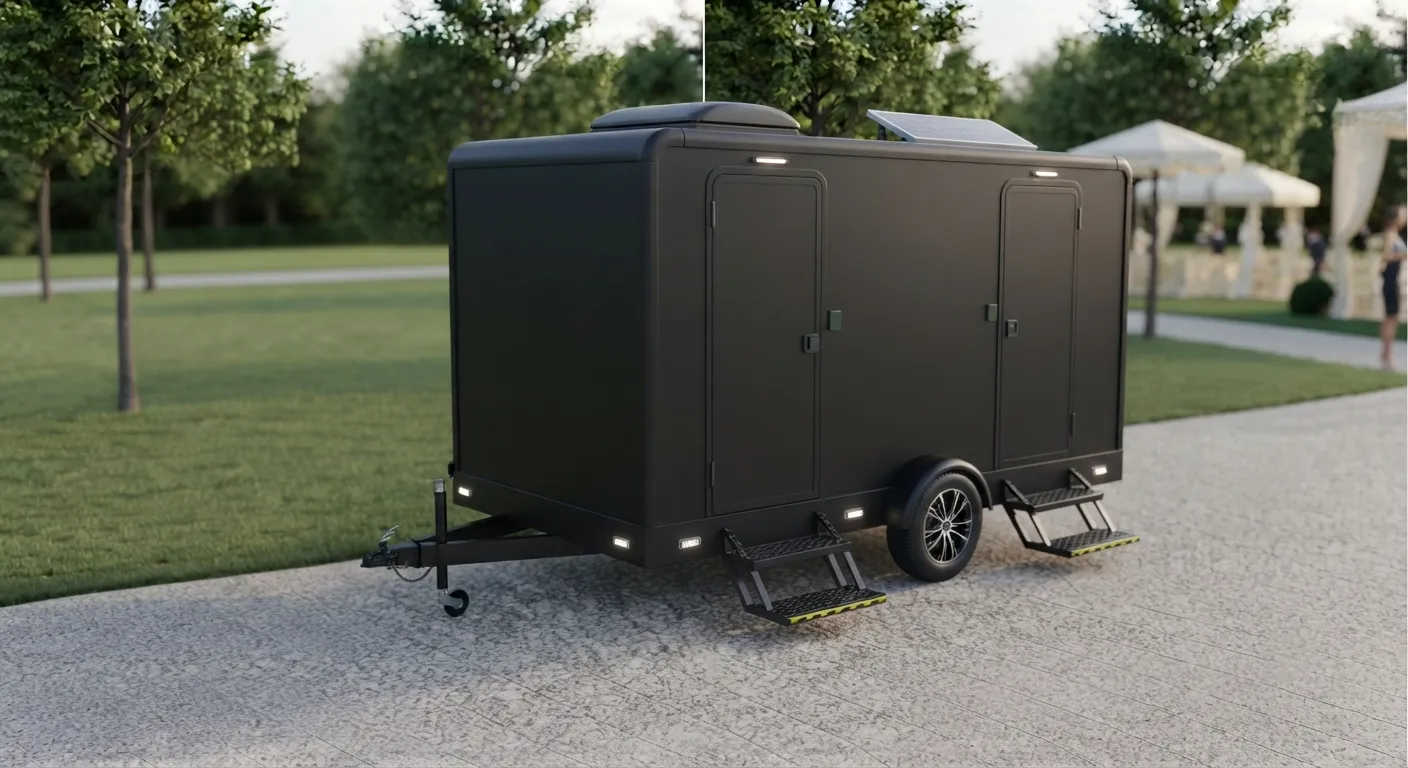
Races that draw a big finish-line crowd sometimes add a restroom trailer instead of a straight bank of standard units, especially for a ticketed marathon expo. A 4 stall trailer handles heavier finish-line traffic better than six separate doors spread across a muddy field. Whatever you pick, get a quote with your course map attached so the count matches your actual layout, not a generic per-runner formula.
Frequently asked questions
How far in advance should we book restrooms for a race?
Book 4 to 6 weeks out for anything over 500 runners. Race season fills delivery trucks fast, and course logistics like power poles and barrier runs take longer to schedule than a single unit drop. Smaller local 5Ks can often book 2 weeks out.
Do we need an ADA unit even for a small race?
Yes. ADA Standards section 213.2 requires at least one accessible unit anywhere units are clustered, regardless of race size. Place it at both start and finish if your budget allows, since runners and spectators use different ends of the course.
Can restrooms be serviced mid-race for a long event?
Yes, for ultra-distance or multi-day events. A service truck can hit aid stations between waves. For a single-day race under 8 hours, delivery-day servicing is usually enough; ANSI/PSAI Z4.3's weekly interval doesn't apply to a one-day spike.
How do we brace a power pole safely near a finish line?
Guy-wire it at three points or anchor it in a weighted base, and keep it outside the runner lane and spectator flow. Route cords under temporary fencing or matting so no one trips near the finish chute.
Should restrooms be near aid stations or just at start and finish?
Both. Put the bulk of units at start and finish where crowds peak, then add pairs every 2 to 3 miles at aid stations so runners aren't stuck waiting mid-course for a mile-marker stop.
Next step
Get a delivery date
Tell us the address, the dates and the headcount. We size the order and confirm the route.