
How Many Restrooms Does a County Fair Need?
Start with attendance, then multiply. A one-day crowd of 3,000 running 10 hours needs more capacity than the same crowd spread over four days, because turnover and dwell time change the math. ANSI/PSAI Z4.3 sets one service visit per week for up to 10 users over a standard 40 hour work week as the baseline interval, but a fair weekend compresses that into two or three days, so servicing has to scale up, not just unit count. We usually recommend standard portable toilets for general grounds traffic, deluxe flushable units near grandstands or beer gardens, and at least one ADA accessible portable toilet per cluster of units, spaced no more than a short walk apart. If your fair runs a midway, a livestock barn, and a grandstand as three separate zones, each zone needs its own cluster rather than one bank of units in the middle of the grounds. Wyoming, MI fairgrounds with multiple entry gates should mirror that with restroom clusters at each gate, not just the main one. For events large enough to run food vendors, a handwashing station rental belongs next to every food booth, and 29 CFR 1910.141(d)(2) requires soap and towels or a hand-drying device at any washing facility, not sanitizer alone. Fairs with a wash-down area for animal pens or equipment coated in paint, sealant, or pesticide residue trigger a different rule: OSHA 1926.51(f)(1) requires washing facilities specifically where employees handle paints, coatings, herbicides or insecticides. Most fairs never trigger that clause, but livestock and maintenance crews sometimes do. If you are still scoping numbers, our porta potty calculator guide walks through the same math with your own attendance figures.
What Do County Fair Restrooms Cost in Wyoming, MI?
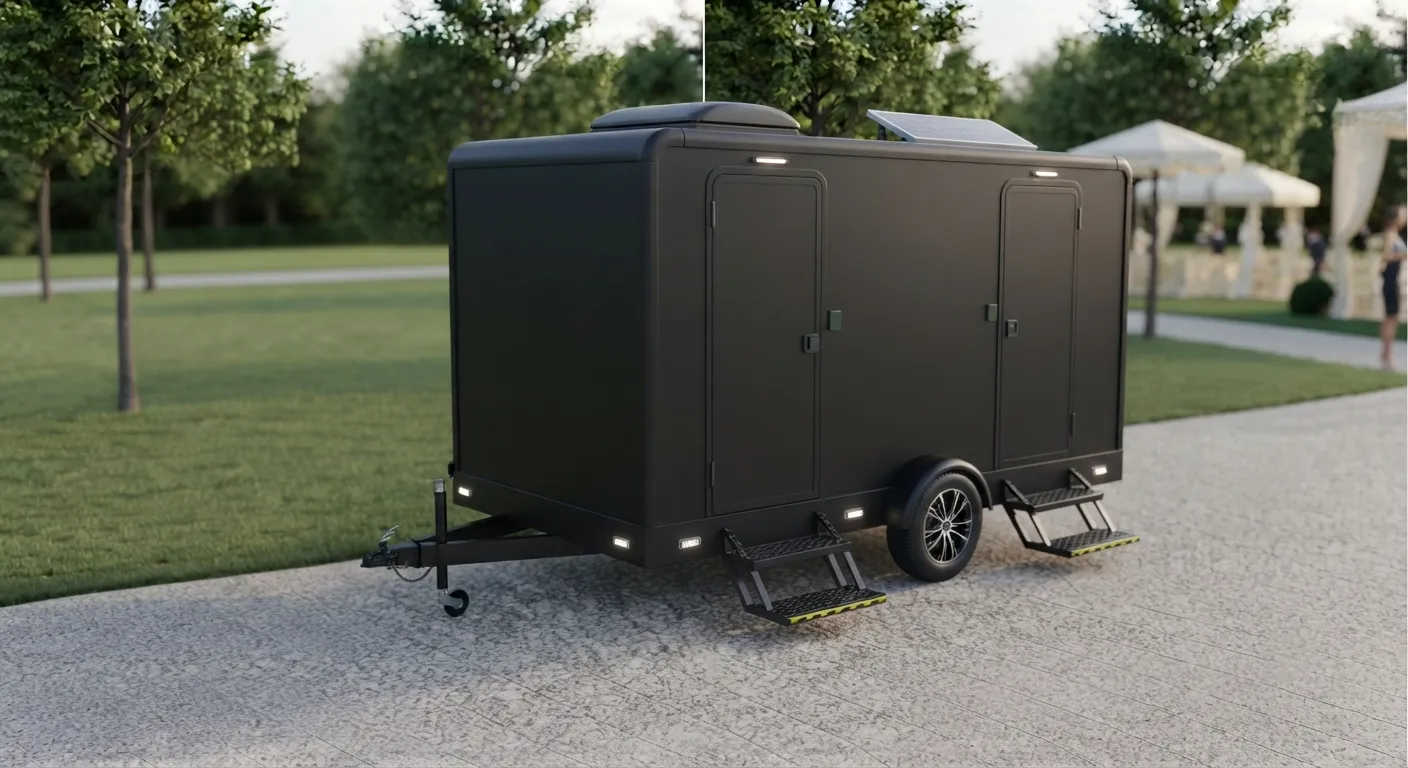
Pricing depends on unit mix, rental length, and how many days the fair actually runs. A single standard unit rented for a multi-day event typically falls in the $200 to $800 range depending on duration and service frequency, while an ADA unit for a comparable weekend runs $199 to $300. Restroom trailers cost more but suit fairs with grandstands, wine gardens, or VIP areas where flush fixtures and running water matter.
| Unit type | Day rate | Weekend rate | Week rate |
|---|---|---|---|
| Standard portable toilet | $100 - $350 | $125 - $400 | $130 - $500 |
| ADA accessible unit | $200 - $400 | $199 - $300 | $240 - $240 |
| Deluxe flushable unit | $85 - $1,200 | - | $150 - $290 |
| Restroom trailer | $175 - $2,500 | $900 - $3,000 | $1,650 - $1,650 |
Delivery adds a separate fee, typically $100 to $500 for a single-day event and $50 to $150 for week-long placement, since fairgrounds often need multiple drop points across the grounds. A service fee also applies for extra pump-outs during multi-day events, generally $30 to $220 depending on frequency. For a full breakdown by unit and duration, see porta potty rental cost or porta potty rental per day if your fair is a single-day event. Fairs that run monthly setups, like extended county exhibitions, should check monthly porta potty rental pricing instead, since day rates do not scale down cleanly over 30 days.
Where Should Restrooms Go on the Fairgrounds?
Placement drives whether people actually use the units without crossing the whole midway. Units need a stable, firm, slip-resistant surface under ADA Standards 302.1, which rules out soft turf or gravel that shifts underfoot, especially after rain turns fairground grass to mud. Every ADA unit needs a 60 inch turning circle nearby per ADA Standards 304.3.1, and a clear accessible route at least 36 inches wide under ADA Standards 403.5.1, so units can't sit wedged between fencing and a food trailer. Our porta potty placement guide covers ground surface, clearance, and delivery truck access in more depth. Delivery trucks need roughly 60 feet of straight clearance behind the vehicle to offload safely, which matters on fairgrounds with tight service roads or livestock lanes. Grandville sits about 4.0 miles west of Wyoming and Kentwood about 6.4 miles east, so if your fair draws from both directions, plan restroom clusters near each parking entrance rather than concentrating everything at one gate. Temporary fencing around restroom clusters keeps foot traffic organized during peak hours; see temporary fence rental if your grounds need crowd channeling near the restroom area. For fairs with vendor row cooking demonstrations, pair units with a portable sink rental so vendors have handwashing access that satisfies both fairgoers and health inspectors.
Frequently asked questions
How far in advance should I book restrooms for a county fair?
Book 4 to 6 weeks out for a multi-day fair, longer if it overlaps another regional event competing for the same equipment. Wyoming Porta Pros can sometimes turn around faster; check emergency porta potty rental if your date is close.
Do county fairs need ADA accessible units?
Yes. ADA Standards 213.2 requires at least 5 percent of clustered single-user units be accessible, with a minimum of one per cluster, even for small fair layouts.
Can we add handwashing stations near food vendors?
Yes, and you should. 29 CFR 1910.141(d)(2) requires soap and towel or drying-device access at washing facilities; see handwashing station rental for vendor-row setups.
What if the fairgrounds don't have paved restroom pads?
We check ground conditions during placement planning. ADA Standards 302.1 requires firm, stable, slip-resistant surfacing, so grass or gravel pads sometimes need matting first.
Do you serve fairgrounds outside Wyoming proper?
Yes. We cover Grandville, Kentwood, Georgetown, Walker, and Plainfield; see service areas for full coverage and driving distances.
Next step
Get a delivery date
Tell us the address, the dates and the headcount. We size the order and confirm the route.